



































The bed goes against the wall because that is the only way it fits. Or there is a radiator on one side and a door that swings open on the other. Or the room is wide enough for the bed and about four inches more. Whatever the specific reason, the result is the same: there is nowhere to put a bedside table, and so there is nowhere to put anything.
So your phone charges on the floor. Your glasses end up on the bed and eventually on the floor too. The book you are reading lives under the pillow. A glass of water sits on the windowsill if you are lucky and on the carpet if you are not.
The usual response is to go looking for a narrower table. A slim one, a stackable one, something 20 centimetres wide that might just squeeze in. This almost never works, because the problem is not the width of the table. It is that there is no floor to put a table on at all.
The way out is to stop thinking about the furniture and start thinking about what the furniture was doing. A bedside table is not one thing. It is four separate jobs bundled into one object, and once you separate them, every one of them can be solved on a vertical surface using no floor space whatsoever.

Why Is There No Room for a Bedside Table?
Usually because of fixed features rather than room size. A bed pushed against a wall removes one side entirely, a door swing or a radiator removes the other, and in narrow rooms the walking path takes whatever is left. Bunk and loft beds remove the option completely, since there is no floor at the right height.
It is worth identifying which of these applies to you, because it determines what you can mount and where.
A bed against a wall is the most common and the easiest to work with. You lose the floor on that side but you gain a wall surface right next to the mattress, which is better than a table for most of what you need.
A door swing or a radiator is more awkward, because the space exists but cannot be permanently occupied. Anything you add on that side needs to fold away or sit above the obstruction.
Bunk and loft beds are their own category. The sleeping surface is nowhere near the floor, so no table at any size would help. Everything has to attach to the bed itself.
Narrow rooms are the cruelest case, because the space technically exists but is the only route to the rest of the room. Anything placed there gets walked into in the dark, which is how it ends up moved within a week.
What Does a Bedside Table Actually Do?
Four things. It holds small items you want within reach, it supports a lamp, it gives you a hard surface for a glass or a book, and it provides somewhere for a charging cable to terminate. Those are four separate jobs, and nothing says they have to be solved by the same object.
This is the reframe that makes the problem solvable. People search for a smaller table because they are thinking in furniture. Think in jobs and the constraint disappears, because none of the four actually requires a horizontal surface standing on the floor.
Small items need containment, not a surface. A lamp needs mounting, not a base. A glass needs a flat spot roughly the size of a coaster. A cable needs a route and an anchor.
The useful question is therefore not where a table would go, but which vertical surface is nearest your pillow. For most people that is either the wall beside the bed or the bed frame itself, and both will take more weight than a narrow table would have held anyway.
Solve the four jobs separately, on that vertical surface, and the floor stays completely clear.

Where Do Your Small Things Go Without a Table?
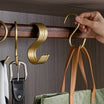
Into something that hangs off the bed itself. A hanging organiser hooks over a bed rail or frame and puts phone, book, glasses and charger at mattress height, within arm's reach while lying down, without touching the floor at all.
This is the job that matters most, because it is the one causing the actual mess. A lamp has nowhere to go and that is annoying. Four loose objects with nowhere to go is what makes the area beside a bed look chaotic.
The Goodinary® Bedside Hanging Organizer is built for exactly this situation. It hangs on adjustable hooks that fit over bed rails, cabinet edges, and other suitable surfaces, so there is nothing to mount, nothing to drill, and nothing standing on the floor. For a rental or a dorm that matters as much as the storage itself.
It measures approximately 13.1 by 4.4 by 4.7 inches (33.2 by 11.3 by 12cm), which is a deliberate size rather than a small one. Deep enough that a phone, a book, a charging cable and a pair of glasses all sit in it without stacking, and narrow enough front to back that it does not stick out into a walkway. The build is sturdy PP plastic and the whole unit is light, which is what lets it hang off a rail rather than needing structural support.
It comes in green, white, and orange, so it can either disappear against the bed or be easy to find in the dark, depending on which you would rather.
Hooking position is the one thing worth getting right. Hang it level with the mattress rather than below it, so you can reach in without sitting up. If the organiser is low enough that you have to lean over the edge to find your phone, you will stop using it and the phone goes back on the floor.
The same organiser works on bunk beds, loft beds, dorm beds, nurseries, and campers, which is really a list of all the places where a bedside table was never going to be an option in the first place.

Where Does the Lamp Go If There Is No Table?
Onto the headboard or the bed frame. A clip-on lamp grips an edge rather than standing on a base, which means it needs no surface at all and can be positioned exactly where you want the light rather than wherever the table happened to be.
A lamp is the job people assume is impossible without a table, and it is the easiest of the four to solve.
The Goodinary® Clip-On LED Lamp attaches directly to a headboard, shelf, or desk edge, so it borrows the structure that is already there. It runs on a USB rechargeable battery, which removes the second hidden requirement of a bedside lamp: being near a plug socket. A corded lamp needs a table and an outlet within reach of the cord. This one needs neither.
The light itself is soft and stable rather than harsh, which suits reading in bed more than a ceiling fixture does.
The practical advantage of clipping rather than standing is aim. A lamp on a table points wherever its shade points. A clip-on can be angled onto the page and away from the rest of the room, which matters if someone else is asleep next to you.
Recharging is the one habit it requires. Charging it on the same cycle as your phone, rather than waiting for it to run out, is what keeps it from becoming a lamp that does not work.

What If You Need a Hard Surface for a Glass?
Mount a small shelf on the wall at mattress height. A glass, a watch, or a book needs only a flat spot a few inches across, and a wall mounted shelf provides that without any floor contact. A folding one is better, because it is out of the way when the surface is not in use.
This is the job the other two do not cover. A hanging organiser is a container, not a surface, and you cannot stand a glass of water in one.
The Goodinary® Foldable Wall Shelves suit this because they do not stay in the way. Each shelf folds down flat against the wall when you are not using it, which is what makes them workable on the side of a bed where a door opens or where you need to squeeze past. A fixed shelf at mattress height in a narrow room is something you walk into. A folded one is not.
They mount with strong adhesive on a clean, smooth surface rather than screws, so no drilling and nothing permanent, and the shelf surface sits at a slight upward angle so items do not slide off the front edge. The build is sturdy plastic with a smooth finish.
The set comes as two pieces, which is more useful than it sounds in this situation. One at mattress height for the glass and the watch, and a second higher up for a speaker, a router, or anything you want off the floor but do not need to reach from the pillow.
They also work outside the bedroom, in a bathroom, kitchen, or office, holding phones, keys, glasses, or small decor, so a spare one rarely goes unused.

How Do You Stop the Charging Cable Falling Behind the Bed?
Anchor the cable instead of relying on the plug's weight. The usual failure is the cable creeping toward the socket every time the phone is unplugged, until the end disappears behind the bed. Clipping or tying the cable at the point where it reaches the bed stops the slide entirely.
This is the fourth job and the only one that needs no purchase at all, which is why it is worth doing first.
The simplest version takes thirty seconds. Tie a loose knot in the cable where it passes the bed frame, or run a small cable tie around the frame and the cable together, so the cable can still slide through your hand but cannot retreat past that point. The end stays where you can find it.
If the organiser is already hanging on the rail, running the cable end into it solves the problem without any extra hardware, because the cable now terminates inside something rather than lying loose.
The other half is where the plug lives. A socket behind the bed is close to useless, since you cannot reach it. An extension lead run along the skirting board to a point beside your pillow is a better arrangement than any amount of cable management at the wall end.
What Should Not Go Beside a Bed?
Anything you are not using daily. The reason a bedside table becomes a pile is that it is a flat surface in a room where things accumulate, and the small capacity you have without one is a limit worth keeping rather than a problem to solve.
This is the quiet advantage of having no table. A hanging organiser and a small shelf hold perhaps six items between them, which is roughly the number of things a person actually needs within reach at night.
Work out what that six is for you. For most people it is phone, glasses, water, book, charger, and whatever else is personal. Everything beyond that was being stored beside the bed rather than used there, and it has somewhere better to be.
The same principle governs the rest of a room, where giving each category of object one fixed place does more than tidying repeatedly, as covered in 8 small upgrades that make a living room feel finished.

Does This Work on a Bunk Bed or a Loft Bed?
It works better there than anywhere, because a bunk or loft bed has no floor beside it and a hanging organiser needs none. The only adjustments are hooking the organiser on the inside of the guard rail rather than the outside, and checking that nothing protrudes into the space below.
Height changes the priorities. On a top bunk, climbing down to retrieve a dropped phone is enough friction that the storage either works or the phone stays in the bed with you, so reach matters more than capacity.
Guard rails are usually the best hooking point, since they are at the right height and already structural. Hook on the sleeping side rather than the outside, where anything hanging becomes a hazard for whoever is below.
For the lamp, a clip onto the guard rail or the frame gives light without a surface, which on a loft bed is the only option there is.
Four Jobs, No Furniture
A bedside table is a bundle, and when there is no room for the bundle the answer is to unbundle it rather than to shop for a smaller version. Hang the small things off the bed rail, clip the light onto the frame, fold a shelf out of the wall for the glass, and tie the charging cable down so it stops disappearing. All four sit on vertical surfaces, none of them touches the floor, and the room you could not fit a table into turns out to have had the space all along, just not where you were looking for it.

What can I use instead of a bedside table in a small room?
Split the functions rather than replacing the furniture. A hanging organiser such as the Goodinary® Bedside Hanging Organizer covers small items, a clip-on lamp covers light, and a small wall shelf covers the hard surface, none of which use floor space.
Where do you put a lamp if there is no bedside table?
Clip it to the headboard or bed frame. A rechargeable option like the Goodinary® Clip-On LED Lamp needs neither a surface nor a nearby socket, and it can be angled at a book instead of at the whole room.
How do you add bedside storage without drilling?
Use hooks and adhesive rather than fixings. Hanging organisers hook over a bed rail with nothing mounted at all, and adhesive shelves attach to a clean, smooth wall, so both come away cleanly at the end of a tenancy.
What do you do when your bed is against the wall on both sides?
Work off the bed frame rather than the walls, since the frame is accessible from the sleeping surface and the walls may not be. A hanging organiser at the foot or head of the bed is usually reachable where a side wall is not.
How do you stop your phone charger falling behind the bed?
Anchor the cable where it passes the bed frame with a loose knot or a cable tie, so it cannot slide back toward the socket. Running the end into a hanging organiser works even better, because the cable then terminates inside something.

Leave a comment
This site is protected by hCaptcha and the hCaptcha Privacy Policy and Terms of Service apply.