


























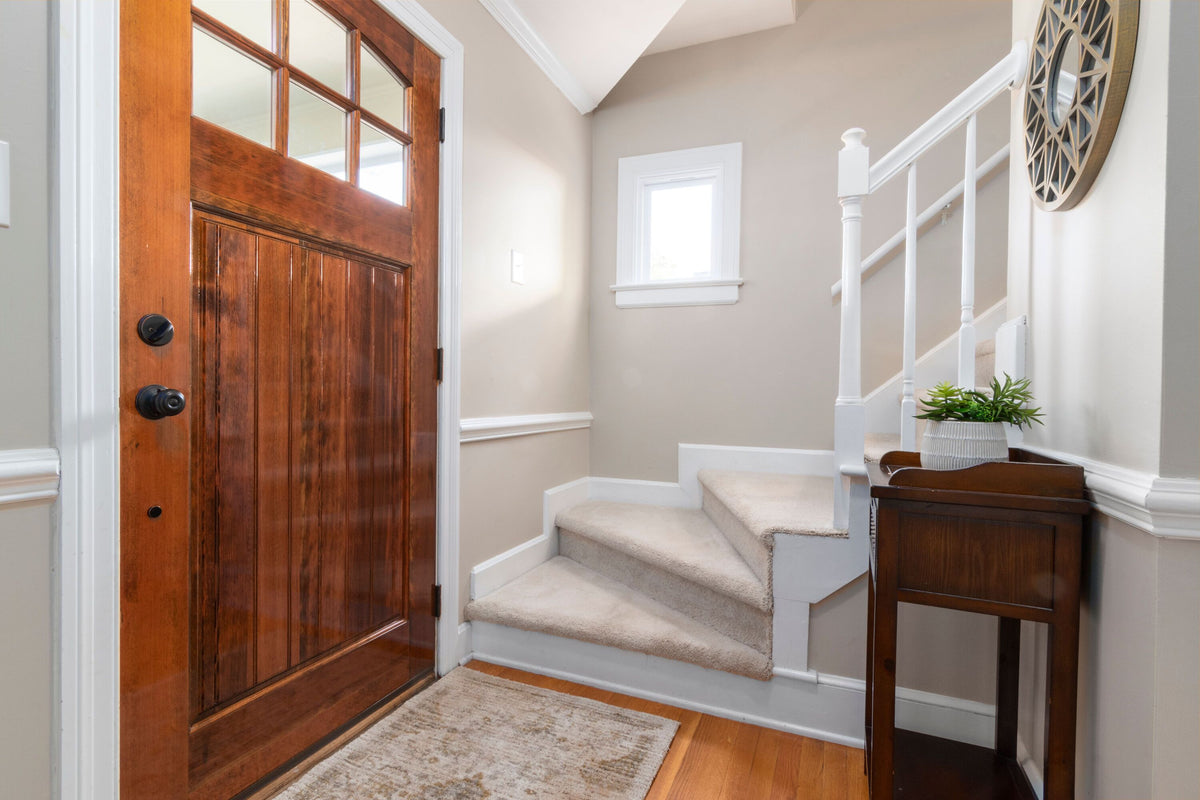
You can keep a kitchen tidy. You can keep a bedroom tidy. Then you walk in the front door and there are four pairs of shoes across the floor, a coat over the back of a chair that is not meant to be there, a delivery box nobody has opened, and a set of keys somewhere in all of it.
The strange part is that the entryway is the smallest space in the house and gets the least use. Nobody sits there. Nothing happens there. And yet it is reliably the worst area in the home, in houses where every other room is under control.
The reason is that the entryway is the only place where three separate jobs happen at once, inside about ten seconds, usually while you are holding something and half out of your coat. Shoes come off. Whatever is in your hands has to go down. And the dirt from outside arrives with you.
Three jobs, ten seconds, and in most homes not one of the three has a place designed for it. So all three default to the floor, which is horizontal, free, and right there. Fix each job separately and the space stops collapsing. Here is how.

Why Is the Entryway Always the Messiest Part of a Home?
Because three things happen there simultaneously and none of them usually has a designated place. Shoes come off, items in your hands need putting down, and dirt arrives from outside. With nowhere assigned, all three land on the floor, and the floor is the one surface that makes the mess visible from every other room.
This is why tidying the entryway never holds. You clear it on Sunday, and by Wednesday it looks the same, because nothing about the underlying arrangement changed. The shoes still have nowhere to go.
It is also why the entryway feels worse than its actual contents justify. A hallway is narrow, so anything on the floor is in the walking path rather than beside it. Four pairs of shoes in a bedroom are invisible. The same four pairs in a hallway are an obstacle course, and you notice them every single time you pass.
And because it is the first thing you see coming home and the last thing you see leaving, a cluttered entryway sets the impression of the whole house, for you and for anyone who visits.

Why Do Shoes Take Over the Floor First?
Shoes are the bulkiest and most numerous thing arriving at a door, and they are the only one that physically cannot go on a wall or a shelf without something to hold them. A household of three generates six or more pairs in circulation, and without structure each pair occupies its own patch of floor.
The arithmetic is what people underestimate. Everyone has the pair they are wearing, the pair they wore yesterday that has not been put away, and whatever is seasonal. Multiply by the number of people in the house and the hallway is holding eight to twelve pairs before anyone has done anything wrong.
Flat storage makes it worse rather than better. A standard shoe rack holds one layer of shoes, so a row of six pairs takes the full length of the rack. The air above each pair, which is most of the space, does nothing at all.
That wasted vertical space is the whole opportunity. A pair of shoes is roughly four inches tall and the gap above them is usually several times that. Filling it is the difference between a hallway that holds your shoes and a hallway that cannot.

How Do You Fit More Shoes in the Same Floor Space?
By stacking pairs vertically instead of placing them side by side. A shoe stacker holds one shoe raised above the other in the footprint one pair would normally occupy, which roughly doubles capacity without the storage taking up any more floor than it already did.
This is the one change that resolves the shoe problem rather than relocating it, because it adds capacity rather than rearranging what is already overflowing.
The Goodinary® Shoe Stacker Rack works on exactly that principle. Each unit is a double layer holder: one shoe sits on the lower plate, its pair sits on the upper, and the two occupy the space of one. The set comes as five units, so it covers five pairs in the floor area that five pairs laid flat would already have taken.
The detail that makes it usable across a real household is the height adjustment. It has three settings at approximately 3.4, 5.5, and 7.7 inches, so the same unit handles slippers at the lowest setting and boots or heels at the tallest. A fixed height stacker fails the moment someone in the house owns a pair taller than it allows, which is why adjustability matters more here than it sounds.
It is made from thick polypropylene with a non slip textured surface and a rear baffle, which is the part that stops shoes sliding off the upper plate when someone knocks the row in a narrow hallway. Assembly is two plates slotting together, so there is nothing to mount and nothing to drill.
The transparent option is worth considering over the green or gold for a practical reason rather than an aesthetic one. Being able to see which pair is in which slot removes the main friction of stacked storage, which is lifting the top shoe to find out what is underneath. If you cannot see in, you stop using it properly within a fortnight.
Placement matters as much as the product. Put the stackers where the shoes already land rather than in a cupboard down the hall, because any storage further away than the habit will lose to the floor.

Where Should Coats, Bags and Keys Actually Go?
On the wall, at the height you reach while still holding things. The second job at a door is putting down what is in your hands, and that needs to happen in one motion without bending, opening a cupboard, or walking further into the house. Hooks at arm height are the only arrangement that reliably beats a chair back.
Most homes do have hooks somewhere. The problem is usually where they are and what they do when nothing is hanging on them.
Here is the specific failure in a narrow hallway. Fixed hooks protrude permanently, so they catch coats and shoulders as people squeeze past, and they stop a door opening fully. People respond by not installing enough of them, which means there are two hooks for four people and the overflow goes on the chair.
The Goodinary® Wooden Wall Mounted Coat Rack with Flip Hooks is built around that constraint. Each hook flips outward to a right angle when you need it and folds back flat against the rack when you do not, so the wall stays clear and nothing is sticking out into the walkway when the rack is empty. In a tight hallway that is the difference between a rack that works and one you keep walking into.
It comes in three, four, and five hook versions, and the right choice is per person rather than per household. One hook each means nobody is hanging their coat on top of someone else's, which is the point at which shared hooks stop being used. Count the people, then add one for bags.
The build is natural bamboo with integrated metal hooks, so it reads as a piece of the hallway rather than hardware bolted to it. The same rack also works in a bedroom, bathroom, or hallway for towels, bags, or hats, which is useful if you end up wanting a second one.

Why Does Everything End Up on the Floor Anyway?
Because putting something away has to be faster than dropping it. At a front door you have roughly ten seconds and at least one occupied hand, so any storage requiring a cupboard door, a bend, or a walk loses to the floor every time, no matter how well organised it is.
This is the rule that explains most failed entryway setups. The storage was not wrong, it was too slow, and the floor won on speed.
Test your own arrangement against it. Stand at the door holding a bag and count what it actually takes to put your coat away. If the answer involves opening something, walking somewhere, or using two hands, that is why it is on the chair.
The fix is almost always to move the storage closer and make it more open rather than to buy more of it. An open hook beats a hanger in a cupboard. A shoe stacker at the door beats a shoe cupboard in the bedroom. Visible and immediate beats neat and distant, every time.

How Much Should an Entryway Hold Before It Overflows?
Only what is in active use. An entryway is a transit space, not storage, and the common mistake is letting it hold the whole household's footwear and outerwear year round. Out of season items belong elsewhere, which usually frees half the space without any new storage at all.
Work out the real number before adding anything. Count the pairs of shoes each person wears in a normal week, which is usually two or three rather than the eight in the hallway. Everything beyond that is being stored at the door rather than kept there.
The same applies to coats. Winter coats in July are taking a hook from something in use, and a hook occupied by something nobody is wearing is functionally not a hook.
A seasonal swap twice a year does more for a hallway than most purchases. Move what is out of season to a wardrobe or a box, and the entryway goes back to holding only what moves through it.

How Do You Stop Dirt Getting Past the Door?
Stop it at the threshold rather than cleaning it off the floors afterwards. Most of the dirt in a home arrives on shoes, so a mat people actually step on does more than any amount of extra vacuuming further inside. Position matters as much as the mat itself.
The arrangement that works is two mats rather than one, because dry grit and wet shoes are different problems. A coarse fibre mat outside the door scrapes loose dirt off the soles before anyone comes in. A water resistant mat inside the door takes the moisture that a scraper mat cannot, which is what otherwise ends up as footprints down the hallway.
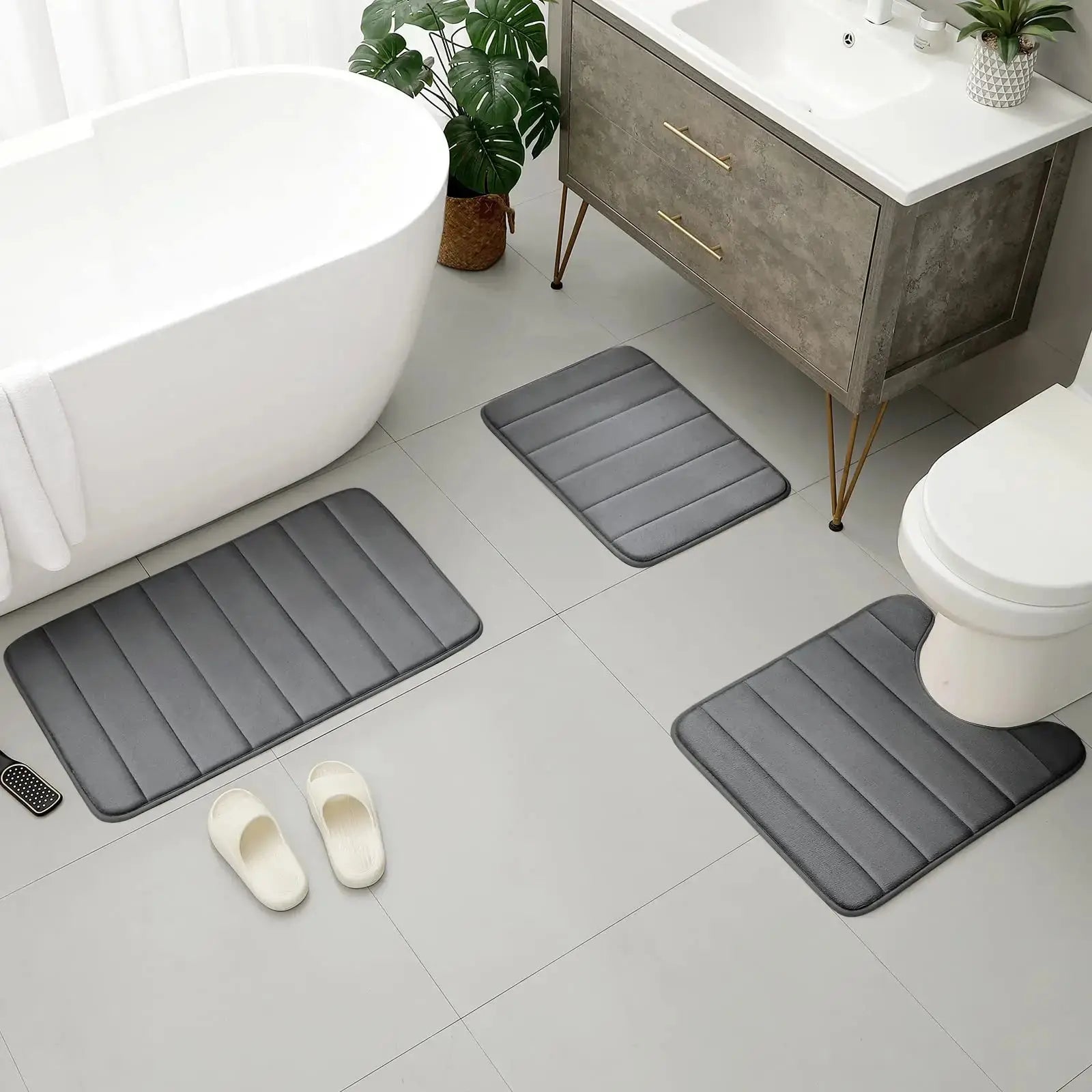
The inside position is the one most homes skip, and it is the one that matters in wet months. The Goodinary® Anti-Slip Doormat is built for it: a waterproof, dustproof polyester surface over a PVC bottom, so it takes water off shoes rather than letting it pass through to the floor underneath.

The PVC backing is the part worth understanding. A mat inside a doorway gets walked on by people still moving at walking pace, often on a hard floor, and a mat that slides under that is worse than no mat at all. The backing grips the floor so the mat stays where you put it instead of creeping forward every time the door opens.
Two sizes, 18 by 30 inches (45 by 75cm) and 24 by 35 inches (60 by 90cm), and the larger one is usually the right call indoors. A mat has to be long enough for a full stride onto it, because one footstep transfers very little. Anything people can cross in a single step is decorative rather than functional. It comes in black, grey, and brown, and the polyester surface wipes and washes rather than needing replacing.
It also works outdoors, on a porch, patio, or in a garage, so if you only want one mat it can take either position. Two positions is better, but one inside beats one outside if you have to choose, because that is where the water lands.
The other habit is unglamorous and free: give the mats a shake out every week or two, so they keep collecting instead of holding what they already caught.
The shoes off rule is the bigger lever and the harder one. It only holds if there is somewhere immediate for the shoes to go, which brings the whole thing back to the first job. People keep their shoes on indoors because taking them off creates a floor problem, not because they prefer it.
The knock on effect reaches the rest of the house, and the same upstream logic applied to floors further in is covered in 8 small upgrades that make a living room feel finished.
Three Jobs, Three Places
An entryway is not messy because the people living there are careless. It is messy because three things happen in it inside ten seconds and most homes have assigned a place to none of them. Give shoes vertical storage at the door, give coats and bags a hook each at arm height, and stop the dirt at the threshold. Each one takes an afternoon at most, and after that the hallway stops being the room you apologise for.

How do you store a lot of shoes in a small entryway?
Stack them vertically rather than lining them up. A stacker such as the Goodinary® Shoe Stacker Rack holds one shoe above its pair in the floor space one pair would use, so capacity roughly doubles without the storage spreading further.
How many coat hooks does an entryway need?
One per person, plus one for bags. Shared hooks stop getting used as soon as coats start stacking on each other, which is the point at which the chair becomes the default.
Will wall hooks make a narrow hallway feel tighter?
Fixed ones will, since they protrude whether or not anything hangs on them. Folding hooks like those on the Goodinary® Wooden Wall Mounted Coat Rack sit flat against the rack when empty, which keeps the walkway clear.
Why does my entryway get messy again a few days after tidying it?
Because tidying moves things without giving them a place. If the shoes had nowhere to go before, they still have nowhere to go, so the same pile forms within days regardless of how thoroughly it was cleared.
Where should shoes be stored if there is no space by the door?
As close to the door as you can get, even if that means a different wall or under a bench. Storage further away than the habit loses to the floor, so proximity matters more than how tidy the storage itself looks.
Do you need a doormat inside as well as outside?
In wet months, yes. An outside mat scrapes dry grit but cannot take moisture off shoes, which is what becomes footprints indoors. A water resistant mat inside, such as the Goodinary® Anti-Slip Doormat, handles the water that gets past the first mat.
What size should an entryway mat be?
Long enough that people take a full stride on it rather than one step, since a single footstep transfers very little dirt. Around 24 by 35 inches suits most doorways; anything people can clear in one step is decoration rather than a working mat.


Leave a comment
This site is protected by hCaptcha and the hCaptcha Privacy Policy and Terms of Service apply.