




















































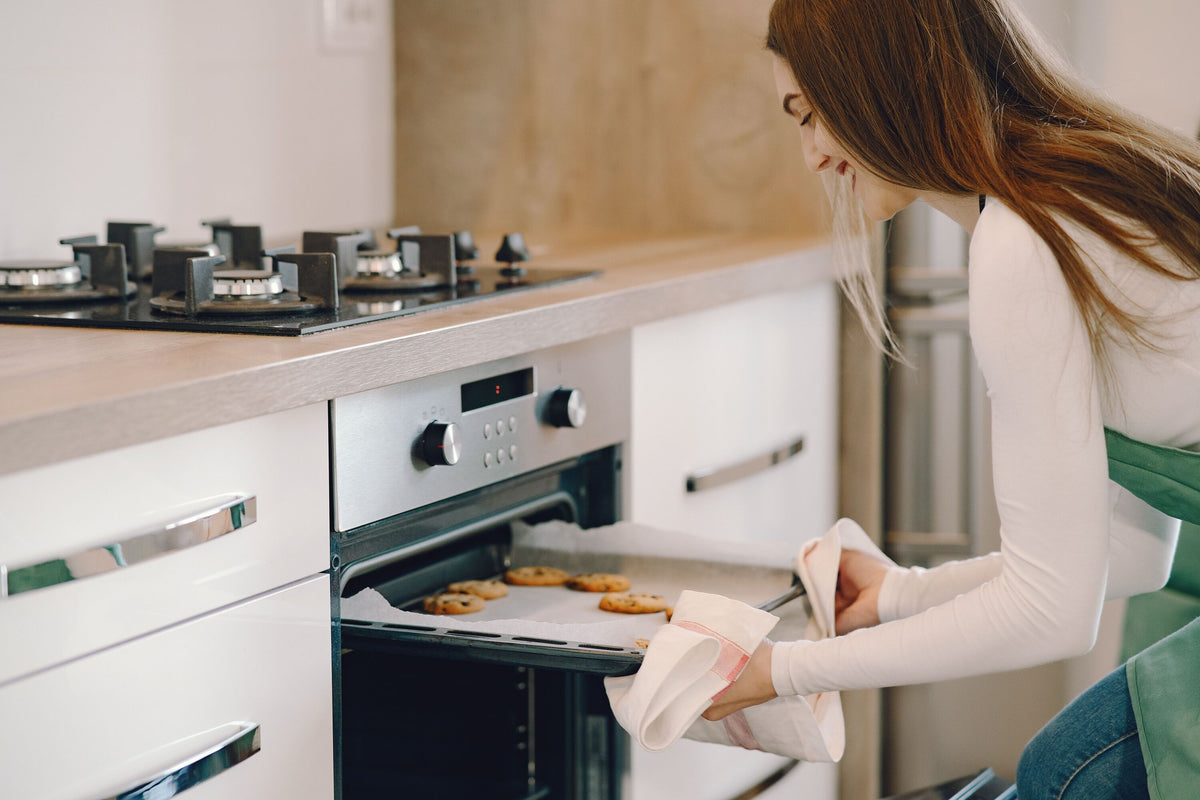
You have made the same cookies four times. The first batch was perfect. The second spread into one continuous sheet. The third was fine. The fourth came out pale and cakey, and you are fairly sure you did the same thing each time.
This does not happen with most cooking. If a stew tastes thin you add salt. If a sauce is too loose you reduce it. You taste, you adjust, and the dish arrives where you wanted it regardless of how precisely you started.
Baking removes that entirely. Once the tray goes in the oven, every decision you made is locked. You cannot taste raw dough and correct the flour. You cannot add more leavening at minute six. Whatever ratios you built, the oven commits to them.
That is the whole reason baking feels unpredictable while cooking does not. It is not that baking is harder. It is that baking has no feedback loop, so small differences that would never matter in a pan become the difference between a good batch and a thrown-away one. Here is where those differences actually come from.

Why Does the Same Recipe Give Different Results?
Because baking is a set of ratios that get locked the moment the tray goes in. Cooking lets you taste and correct as you go, so imprecision gets absorbed. Baking has no correction step, which means every small variation in how you measured arrives intact in the finished result.
This reframes what a recipe is. A cooking recipe is a direction of travel. A baking recipe is a specification, and the gap between following it approximately and following it exactly is where inconsistency lives.
It also explains why experienced bakers seem to get consistent results with no apparent effort. They are not measuring more carefully each time out of discipline. They have set up a method that produces the same numbers without having to concentrate, which is a different thing and a much easier one to sustain.
The variation almost always enters at one of three points: how you get the ingredient out of the bag, what you measure the small quantities with, and how uniform the pieces are when they go in. Each is fixable, and none of them requires more skill.

How Much Does Scooping Flour Actually Vary?
A great deal, because flour compacts. Pushing a cup into the bag presses flour down and packs more into the same volume than spooning it in loosely would. The cup is the same size every time. What goes into it is not, and that difference carries through the whole recipe.
This is the single largest source of variation in home baking and the one almost nobody is aware of. Two people following the same recipe with the same cup can end up with meaningfully different amounts of flour, and so can the same person on two different days depending on how firmly they dug into the bag.
It gets worse over the life of a bag. Flour settles as it sits, so a scoop from a bag that has been in the cupboard for a month is denser than a scoop from one opened yesterday. Nothing about your technique changed. The flour did.
If you only change one thing after reading this, change how you fill the cup. Stir the flour in the bag to loosen it, spoon it into the cup rather than scooping, and level the top with a straight edge rather than tapping it down. That alone removes most of the inconsistency in a cookie or cake recipe.
The same applies to anything powdered that compacts, which includes cocoa, icing sugar, and ground almonds.

What Should You Measure Small Ingredients With?
Dedicated measuring spoons, levelled rather than heaped. Cutlery varies enormously between sets, so a teaspoon from your drawer is not a teaspoon of volume, and the difference matters most in exactly the ingredients where being wrong is most damaging.
This is the correction people skip because it feels trivial. It is not trivial. Baking powder, bicarbonate of soda, salt, and yeast are all in a recipe in small quantities and all have large effects, so an eating teaspoon used instead of a measuring teaspoon can be the whole reason a batch failed.
The real reason people reach for cutlery is that a proper set of measuring spoons is annoying to own. A ring of six or eight tangles in the drawer, and finding the right one takes longer than grabbing a teaspoon from the tray.
The Goodinary® Folding Measuring Spoon is three measurements in one folding tool instead of separate spoons on a ring. Both pieces are 0.1 inches thick, so they lie flat in a drawer, and the silicone has built-in magnetism so they hold together rather than separating into the back of it.
The habit that makes the tool work is levelling. Fill past the top, then scrape across with the back of a knife so the measure is flat. A heaped teaspoon of baking powder can be close to double a level one, which is enough to change how a cake rises.
The same drawer logic applies to the rest of a kitchen's small tools, which is covered in why keeping knives in a drawer ruins them.

When Is a Spoon Not Accurate Enough?
When the ingredient compacts, when the quantity is small enough that a small error is a large proportion, or when you are trying to reproduce a result exactly. In those cases weight is the only measurement that does not change with how the ingredient was handled.
This is the step that separates baking that is usually fine from baking that is the same every time. A gram is a gram regardless of whether the flour was packed, settled, or fluffed. A spoon is only as consistent as the hand filling it.
A full bowl scale is the thorough answer, and the reason people skip it is the setup: fetch the scale, find a bowl, zero it, repeat. The Goodinary® Measuring Spoon Scale is a spoon with a digital readout in the handle instead, so the scoop and the reading are the same motion.
Two functions do most of the work. Tare rezeros the display with the spoon already loaded, so a second ingredient can go on top of the first and you read only the new amount. Hold freezes the number, which is what lets you read it once the spoon is tipped.
It handles up to 500g, which covers the ingredients where weight matters without replacing a bowl scale on a large bake. In practice the two tools split the job: the folding spoons for everything you are confident about, the scale for the leavening, the salt and the yeast.

Why Do Some Cookies Burn While Others Stay Raw?
Because they are different sizes. A tray goes into one oven at one temperature for one length of time, so every piece on it needs to be the same size and thickness to finish together. Hand-cut or hand-rolled pieces vary, and the oven treats that variation as if it were intentional.
This is the cause people never suspect, because it has nothing to do with the recipe. The batter was right. The oven was right. The pieces were not the same.
Think about what actually happens on the tray. A piece that is two thirds the size of its neighbour is done well before the neighbour is, and by the time the larger one is ready the smaller one has gone past dark. You then split the difference, pull the tray somewhere in the middle, and end up with a batch where nothing is quite right.
Cutting every piece with the same cutter removes the variable entirely, which is what the Goodinary® Cookie Cutter Set is for. Twelve stainless steel shapes, and a steel edge cuts cleanly rather than dragging, which matters because a dragged edge compresses the dough at the rim and that rim then bakes differently from the middle.
The other half of uniformity is thickness, and no cutter can fix that. Roll to an even depth across the whole sheet rather than thinning at the edges, which is where most unevenness in a rolled batch comes from. Rolling between two strips of wood or two rulers of equal height is the simple way to force this.

Does Your Oven Actually Run at the Temperature on the Dial?
Often not. Domestic ovens commonly run warmer or cooler than the setting, and almost all of them have hot spots where one part of the oven is more intense than another. The recipe assumed an accurate oven, and yours may not be one.
This costs nothing to work around once you know. Rotate the tray halfway through the bake so no piece spends the whole time in the hottest part. If one corner of your oven consistently browns faster, that is a hot spot and it will do it every time.
The dial itself is worth testing rather than trusting. If your bakes are consistently done early, the oven runs hot and the fix is to set it lower rather than to shorten every recipe. If they are always underdone at the stated time, the opposite.
Preheating properly is the other half. An oven that beeps is not necessarily at temperature throughout, since the air reaches the setting well before the oven walls do. Giving it another ten minutes after the beep makes the first tray behave like the second.

Why Does Ingredient Temperature Change the Result?
Because fat behaves completely differently depending on how cold it is. Butter straight from the fridge does not cream into sugar the same way softened butter does, and cold eggs change how a batter emulsifies. Two bakes with identical quantities can still differ if one started cold.
This is why the same recipe behaves differently in summer and winter, and why a batch made right after shopping differs from one made with ingredients that have been sitting out.
The instruction to use room temperature butter and eggs is not a formality. It is specifying a physical state, and skipping it changes the structure of the finished bake regardless of how precisely you measured.
The practical version is to take what you need out of the fridge when you decide to bake rather than when you start. Twenty to thirty minutes is usually enough, and it costs nothing but sequence.
How Do You Make a Recipe Repeatable?
Write down what you actually did, not what the recipe said, and change one thing at a time. Consistency comes from knowing which version produced the good batch, which is impossible if you adjusted three things at once and cannot remember which.
Keep it crude. A note on your phone saying which oven setting, which shelf, how long, and anything you changed is enough. The point is not record keeping for its own sake. It is being able to repeat a success.
Change one variable per bake when you are adjusting. If a batch spread too much and you reduce the butter, lower the oven, and chill the dough all at once, you have learned nothing about which of the three mattered.
And make the same recipe several times before judging it. A recipe tried once tells you about one bake, not about the recipe.
Precision Is a Setup, Not an Effort
Consistent baking is not about being careful. Careful is unsustainable and you will stop doing it. It is about arranging things so the same numbers happen whether or not you are paying attention: spoons that measure rather than cutlery that approximates, weight for the ingredients where percentage errors show, and pieces that are the same size so one bake time fits them all. Set that up once and the question stops being whether this batch will work. It becomes what you want to bake.

Should you weigh or measure baking ingredients?
Weigh anything that compacts or where a small error is a large proportion, such as leavening, salt, and yeast. Measure the rest by volume, since fetching a scale for every ingredient is the kind of effort people abandon after two weeks.
Why does the same cookie recipe spread differently each time?
Usually flour quantity or butter temperature. Scooped flour varies with how packed it is, and softened butter spreads more than cold butter, so either one will change how far the dough runs on the tray.
What is the right way to measure flour in a cup?
Stir the flour to loosen it, spoon it into the cup, then level the top with a straight edge. Do not scoop with the cup and do not tap it down, since both compact the flour and add more than the recipe intended.
Are measuring spoons really different from normal teaspoons?
Yes, and noticeably. Cutlery varies between sets and is not made to a volume standard. A folding set such as the Goodinary® Folding Measuring Spoon covers several measures in one flat tool, which removes the usual reason people reach for cutlery instead.
How do you stop cookies baking unevenly on the same tray?
Make them the same size and thickness. Cutting with a single cutter such as the Goodinary® Cookie Cutter Set handles the outline, and rolling to an even depth across the sheet handles the rest.



Leave a comment
This site is protected by hCaptcha and the hCaptcha Privacy Policy and Terms of Service apply.